AdBlock Detected!
Our website is made possible by displaying ads to our visitors. Please supporting us by whitelisting our website.
CSS Z-Index |
|
The z-index property specifies the stack order of an element. In other words, when there is an overlap between two elements, the z-index value determines which one shows up on top. The element with a larger z-index value will appear on top. The picture below illustrates the z-index concept. The x-axis and the y-axis specify the two dimensions that define the display area. The z-axis the third dimension that connects the display area to the eye. The stacked elements are elements that appear in different positions on the z-axis. In this example, stacked element 1 appears closer to the eye than stacked element 2. You can think of the positions as being defined by an index of the z-axis, hence the name z-index. 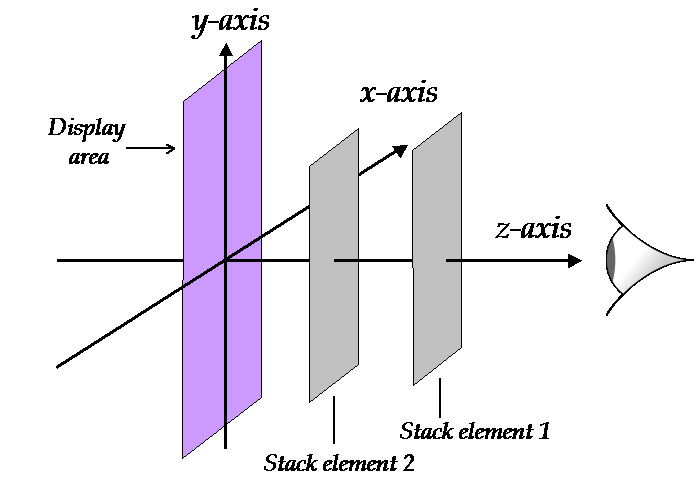 The allowable values for z-index are:
Note that z-index only works on elements that have one of the following three position declarations: position:relative, position:absolute, and position:fixed. In addition, number must be an integer, and negative numbers are allowed. For example, say we define two blocks with the following CSS code:
The following HTML code,
renders the following:
As we can see, the pink block, with a z-index value of 2, lies on top of the red block, which has a z-index value of 1. |
Our website is made possible by displaying ads to our visitors. Please supporting us by whitelisting our website.